
What Evo-Devo Reveals About the Origins of Complexity
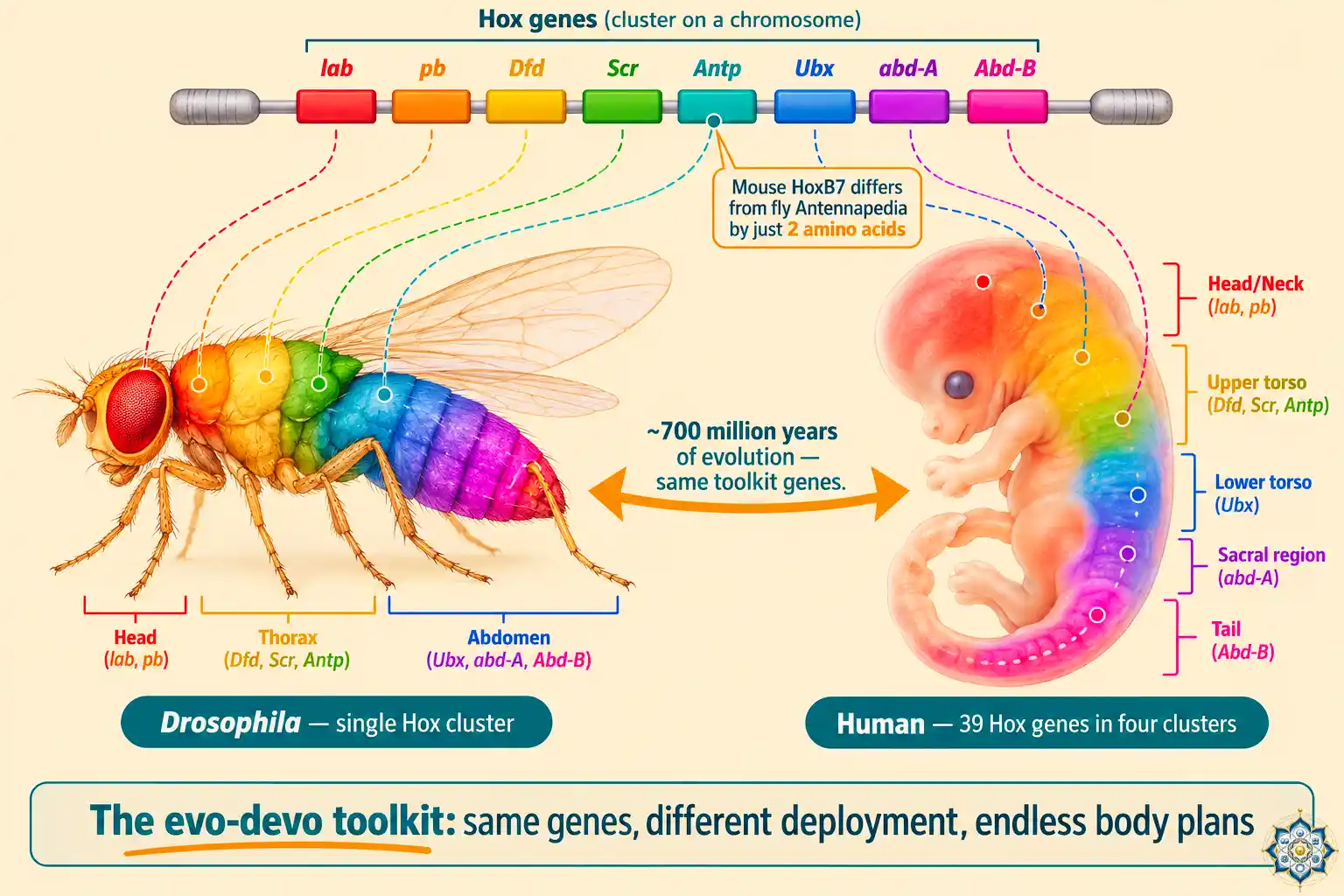
Evo-devo — short for evolutionary developmental biology — is the discipline that answered one of the biggest puzzles in biology: how does evolution produce the staggering diversity of animal body plans using the same small set of genes?
Consider two numbers that shouldn’t fit together. Human beings and fruit flies share more than 60% of their genes. A mouse and a human share about 85%. Even a sea sponge — an animal with no symmetry, no nervous system, and no muscles — carries recognizable versions of the same core genes used to build you.
If evolution works by changing genes, and the genes are mostly the same, where does the difference come from? Why does a mouse have four legs and a snake have none? Why does a butterfly have eyespots on its wings and a beetle doesn’t?
For most of the 20th century, biology had no satisfying answer. Genetics explained how traits were inherited. Molecular biology explained how proteins were built. But neither could explain how a fruit fly and a horse — both built from similar genes — could end up looking so different.
Then, in the 1980s and 1990s, a new field cracked it open. The answer wasn’t in which genes animals had. It was in when, where, and how much those genes were switched on. A small universal “toolkit” of ancient genes, deployed differently, could produce every body plan on Earth.
This is the story of evo-devo — the field that showed how complexity arose not by inventing new genetic parts, but by rewiring the same old parts in new ways.
The puzzle evo-devo had to solve
In 1894, the British geneticist William Bateson coined the word homeotic to describe a strange kind of mutation: one body part replaced by another. A fly with legs growing where its antennae should be. A plant with leaves where petals belonged.
These weren’t just deformities. They suggested something profound — that body parts were under the control of discrete “switches,” and when a switch flipped, an entire organ could be swapped for another.
Bateson didn’t know how it worked. The genes behind these transformations wouldn’t be identified for another 90 years. But he had intuited the key insight: body plans are modular, and the modules are controlled by a small number of master signals.
The puzzle came into focus with the rise of molecular biology. By the 1970s, biologists could compare the DNA of different species. What they found was unexpected: animals as different as fruit flies and mice shared huge stretches of nearly identical genetic sequence. The genes themselves weren’t the difference. Something else was.
The toolkit genes: a small universal set
The first breakthrough came from an unlikely source — the fruit fly, Drosophila melanogaster. In the late 1970s, Edward B. Lewis at Caltech, working with Christiane Nüsslein-Volhard and Eric Wieschaus, systematically identified the mutations that disrupted body plan formation in fly embryos. Their work earned them a shared Nobel Prize in Physiology or Medicine in 1995.
What they found was a small group of genes that acted like master switches. Each one controlled the identity of a specific body region. Shut one off, and the fly developed an extra pair of wings. Turn one on in the wrong place, and legs grew where antennae should be.
These were the Hox genes — the first and most famous members of what Sean B. Carroll and others would later call the evo-devo toolkit.
The toolkit turned out to be surprisingly small. Perhaps a few hundred genes, out of the ~20,000 in a typical animal genome, do most of the work of specifying body plans. They include:
- Hox genes — specify position along the head-to-tail body axis
- Pax genes — specify where sensory organs form (including eyes)
- Distal-less (Dlx) — specifies where appendages grow (limbs, fins, wings)
- BMPs (Bone Morphogenetic Proteins) — pattern bones, beaks, and dorsal-ventral axis
- Wnt genes — direct cell fate and tissue identity
- Sonic Hedgehog — patterns limbs, brain, and the body midline
Most of these genes encode transcription factors — proteins that bind DNA and switch other genes on or off. A few encode signaling molecules that cells use to tell their neighbors what to do. Together, they form the regulatory layer that sits on top of the genome and decides how the rest of the ~20,000 genes get used.
Hox genes: the architects of the body axis
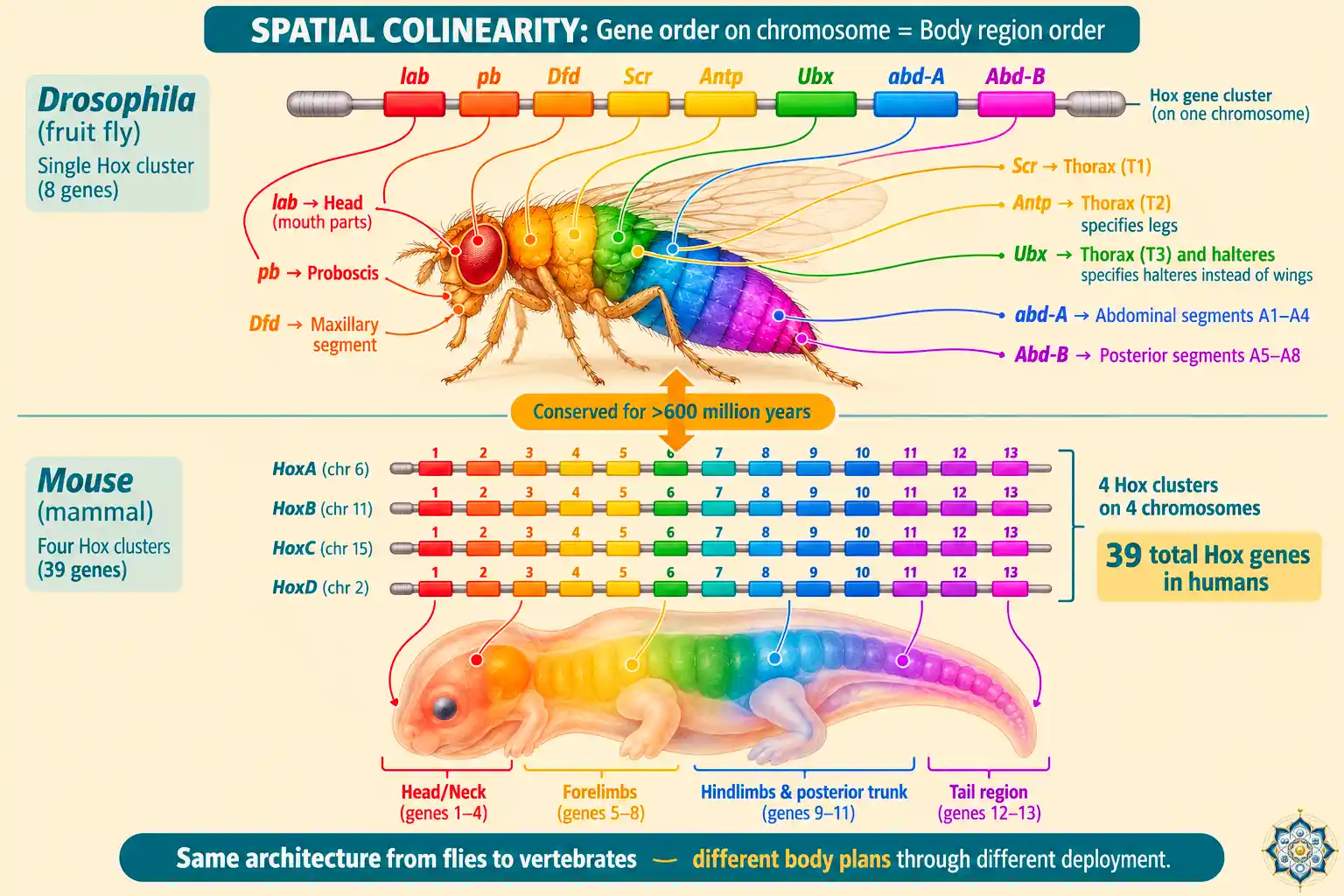
Hox genes have a remarkable property called spatial colinearity: the physical order of the genes along the chromosome matches the order of the body regions they control.
In a fruit fly, the eight Hox genes sit in a single cluster. The gene at one end — labial — controls head development. Moving along the chromosome, you pass genes that control the mouth, the thorax, the first set of legs, the wings, the halteres, and finally the abdomen. The last gene — Abdominal-B — specifies the fly’s rear segments.
Vertebrates — including humans — have the same system, but duplicated. Through two rounds of whole-genome duplication early in vertebrate evolution, the single Hox cluster became four. Humans have 39 Hox genes arranged in four clusters (HoxA, HoxB, HoxC, HoxD) on four different chromosomes. The spatial colinearity still holds: the “front end” genes control head and neck development; the “back end” genes control the tail region and limbs.
In the human embryo, these Hox genes begin activating during gastrulation — the Week 3 event in which the primitive streak forms the head-to-tail body axis and the three germ layers that every tissue will arise from. The spatial colinearity of the Hox cluster then gets translated, almost line by line, into the spatial map of the body.
The classic experiments: Antennapedia and Ultrabithorax
Two Hox mutations gave the field its most famous demonstrations:
Antennapedia is normally expressed in the fly’s thorax, where it specifies “make legs here.” When a mutation causes it to also switch on in the head, the result is a fly with legs growing out of its head where antennae should be. The gene hasn’t invented a leg — it’s just told head cells to run the “leg” program instead of the “antenna” program.
Ultrabithorax (Ubx) normally suppresses wing formation in the third thoracic segment, which develops into the halteres — small balancing organs that evolved from a second pair of wings in ancient flies. When Ubx is disrupted, those halteres transform back into full wings. The famous four-winged fly — created by Lewis’s mutations — is a window into what the ancestral two-winged fly’s great-great-grandparents looked like.
How conserved is this? Shockingly conserved
The real surprise came when researchers started comparing Hox genes across species. The sequences were almost identical.
- Mouse HoxB7 differs from fly Antennapedia by just 2 amino acids out of 60 in the critical DNA-binding region
- Mouse HoxB6 can be inserted into a fruit fly in place of Antennapedia — and it produces legs instead of antennae, exactly as the fly’s own gene would
- Humans and arthropods share the same cluster architecture despite more than 500 million years of separate evolution
Think about what this means. The last common ancestor of mice and fruit flies was a small worm-like creature that lived in the Precambrian seas, more than 600 million years ago. Both lineages have evolved independently ever since — producing beetles and butterflies on one side, mice and humans on the other. Yet both groups still use the same genetic switches to tell cells where in the body they are.
The Hox system wasn’t invented separately in each lineage. It was inherited, nearly intact, from a shared ancestor older than almost everything else in biology.
Pax6: one gene builds every eye on Earth
The second great evo-devo discovery came in 1995, when Walter Gehring’s lab at the University of Basel did an experiment that should have been impossible.
Eyes had long been considered a textbook case of convergent evolution — the idea that different animal lineages had independently invented eyes multiple times. Insect compound eyes, squid camera eyes, scallop mirror eyes, human lens eyes — they look so different, surely they evolved from scratch each time?
Not quite.
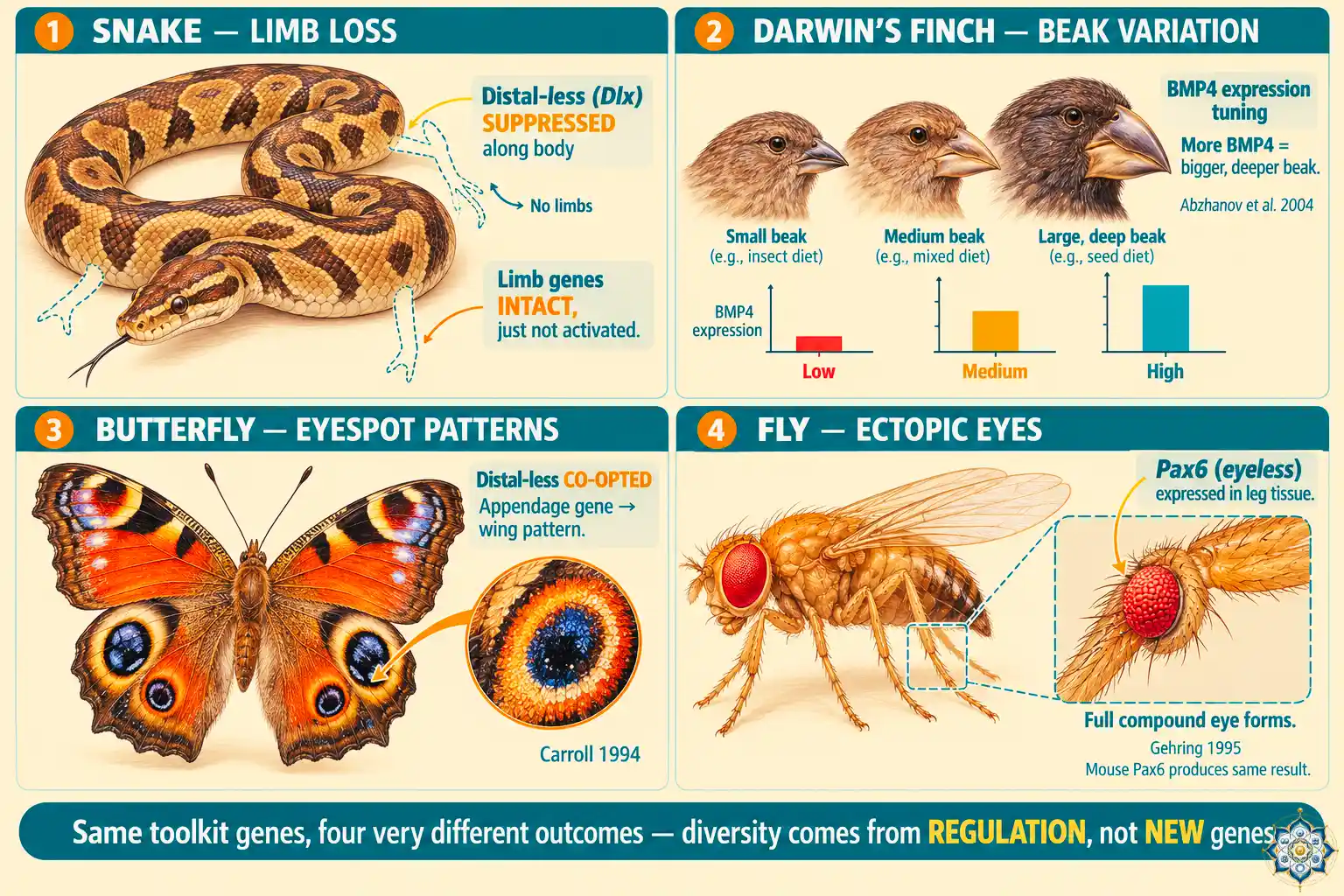
Gehring’s team took the fruit fly gene eyeless — known to be required for eye development — and switched it on in fly tissue where eyes don’t normally grow: wings, legs, antennae. The result:
Fully structured eyes grew where they had been commanded. Compound eye tissue, with ommatidia, photoreceptors, pigment cells — all built by a single switch applied to the wrong tissue.
But the real shock came next. The team swapped in the mouse version of eyeless — a gene called Pax6 — and expressed it in fruit fly tissue instead. The result: fly tissue grew fly-type compound eyes, triggered by a mouse gene.
The implication was staggering. The master switch for eye development is the same gene in insects and mammals, despite over 500 million years of independent evolution. What differs is not the switch — it’s the downstream genes that each lineage uses to build its particular kind of eye.
Deep homology: the shared ancient toolkit
Discoveries like Pax6 and the Hox genes led to a new concept: deep homology.
Classical homology is about structures that look alike because they inherited them from a common ancestor — the five-finger pattern in human hands, bat wings, and whale flippers all trace back to the limbs of early tetrapods. Deep homology goes further: it refers to the shared genetic machinery that builds analogous structures, even when the structures themselves evolved independently.
A fly’s compound eye and a human’s camera eye are structurally different. They’re not homologous as organs. But they both develop under the control of Pax6. The regulatory machinery is homologous, even when the structure it builds isn’t.
The same pattern shows up elsewhere:
- Appendages — insect legs, fish fins, and vertebrate limbs all develop under the control of Distal-less (Dlx), despite having evolved separately
- Hearts — the gene tinman in flies and its vertebrate homolog Nkx2.5 both specify “heart tissue here”
- Nervous systems — the same Hox genes that pattern the fly brain pattern the vertebrate hindbrain
Life’s deep structure, it turns out, is far more unified than the surface diversity suggests.
If the genes are the same, how does diversity happen?
This is the central question of evo-devo, and the answer transformed how biologists think about evolution.
Diversity doesn’t come from inventing new toolkit genes. It comes from changing when, where, and how much the existing toolkit genes get used. Four main mechanisms do the work:
1. Changes in gene expression patterns
The toolkit genes stay the same, but a lineage evolves to switch them on in different places or at different times. Snakes, for example, have the same limb-building genes as other vertebrates. But the gene Distal-less (Dlx), which triggers limb development, is massively suppressed along the snake body. The limb program is intact; the signal to start it just never fires.
2. Changes in regulatory DNA
The coding sequence of a toolkit gene (the part that makes the protein) is usually conserved. But the regulatory DNA around it — the enhancers and promoters that control when and where it turns on — can evolve freely. Most of the real action in evolution happens in these regulatory regions, not in the genes themselves.
3. Gene co-option
A toolkit gene gets used for a new job. In 1994, Sean B. Carroll’s team showed that Distal-less — the appendage gene — had been co-opted in butterflies to pattern the eyespots on butterfly wings. The same gene that specifies “grow a limb here” was now specifying “put a decorative spot here.” Nothing about the gene changed. What changed was the context in which it was deployed.
4. Changes in signal strength
Sometimes evolution works just by tuning the volume on existing signals. The classic case: Darwin’s finches. In 2004, Abzhanov and colleagues showed that differences in beak shape across finch species on the Galápagos could be traced to differential expression of a single gene — BMP4. More BMP4 produced bigger, deeper beaks; less produced smaller, more pointed ones. No new genes required; just different volume settings on an old one.
The Cambrian explosion in evo-devo terms
For most of life’s history, animals were simple. Soft bodies, radial symmetry, few cell types. Then — in a geological blink around 540 million years ago — nearly every major animal body plan on Earth appeared at once. Arthropods, molluscs, vertebrates, echinoderms, chordates. The Cambrian explosion.
What caused it? Evo-devo offers a compelling partial answer.
In the hundreds of millions of years before the Cambrian, the ancestors of modern animals accumulated the toolkit. Hox genes, Pax genes, Distal-less, BMPs — all appear to have existed in some form in the last common ancestor of all bilaterally symmetric animals, which lived in the Ediacaran period before the Cambrian.
Once the toolkit was in place, the regulatory possibilities exploded. The same genes could be rearranged, co-opted, duplicated, and redeployed to create radically different body plans — segments arranged in different numbers, limbs on different segments, eyes in different places, hard shells and soft bodies.
The Cambrian wasn’t an explosion of new genes. It was an explosion of new regulatory arrangements of a toolkit that had been quietly assembling for the previous half-billion years.
Facilitated variation: why evolution is faster than it looks
In 2005, Marc Kirschner and John Gerhart published a book called The Plausibility of Life, which laid out a concept they called facilitated variation. It’s one of the most important ideas to come out of evo-devo.
Their argument: evolution isn’t a slow, blind search through genetic possibilities. The toolkit genes and the regulatory architecture of animals act as a kind of evolutionary scaffolding that makes some kinds of change much more likely than others.
Three reasons the scaffolding works this way:
- Modularity — body parts are built by semi-independent genetic modules, so you can change one without disrupting the whole organism (change beak size without breaking the brain)
- Weak linkage — regulatory genes act through signals that trigger existing responses, so small genetic changes can produce coherent large-scale effects
- Exploratory behavior — many developmental processes are self-organizing. Blood vessels grow where oxygen is needed; nerves wire where signals attract them. This means that when a bone grows longer, the vessels and nerves follow automatically — no additional mutations required
Facilitated variation explains something that classical neo-Darwinism struggled with: how major evolutionary changes could happen quickly, without requiring enormous numbers of simultaneous favorable mutations. The architecture itself does much of the heavy lifting.
Four classic cases that defined the field
| Case | Key gene(s) | What it showed |
|---|---|---|
| Butterfly eyespots | Distal-less | Carroll (1994): an appendage gene was co-opted to create decorative wing patterns |
| Ectopic eyes in fly | Pax6 (eyeless) | Gehring (1995): mouse Pax6 induces fly eyes — same master switch across 500M+ years |
| Snake limb loss | Distal-less, Sonic Hedgehog | Cohn & Tickle (1999): limbs lost by suppression of expression, not loss of genes |
| Darwin’s finches | BMP4, Calmodulin | Abzhanov et al. (2004): dramatic beak differences from differential expression of one gene |
Why this matters for the rest of biology
Evo-devo isn’t a side branch of biology — it rewrites how we understand several other fields.
It explains the DNA similarity paradox
Humans share 99.9% of their DNA with each other, and more than 60% with fruit flies, not because evolution ran out of ideas, but because the toolkit genes are so good at what they do that natural selection preserved them nearly intact for hundreds of millions of years. The diversity we see came from rearranging the regulatory landscape, not from inventing new parts.
It gives regeneration a framework
Animals like the axolotl can regenerate entire limbs because they can still activate the embryonic limb-building program as adults. The toolkit genes that build axolotl limbs are also in your genome — you just can’t turn them on in the right way as an adult. Evo-devo frames regeneration not as a lost capacity, but as a locked one.
It fits with bioelectric control
The bioelectric patterns Michael Levin’s lab studies appear to work in part by directing which toolkit genes get expressed where. Hox gene expression responds to voltage boundaries. Pax6 can be activated by bioelectric cues. The electrical layer and the genetic toolkit are two sides of the same system.
It changes how we think about disease
Many birth defects turn out to be errors in toolkit gene regulation — the gene is fine; the switch that controls it is broken. And many cancers involve the inappropriate reactivation of embryonic developmental programs — which is why a growing number of researchers now say that cancer is development gone wrong, cells running the embryonic toolkit in adult tissue where it doesn’t belong. Understanding how toolkit genes are controlled is becoming central to understanding disease.
Key Takeaways
- Evo-devo (evolutionary developmental biology) explains how a small toolkit of ancient genes creates the diversity of animal body plans
- Hox genes act as master switches that specify body regions; they’re arranged on the chromosome in the same order as the body parts they control (spatial colinearity)
- The toolkit is shockingly conserved — mouse Hox genes can substitute for fly Hox genes across 700 million years of evolution
- Pax6 is the master switch for eye development in every animal that has eyes — same gene, radically different eye structures across species
- Diversity arises from changes in regulatory DNA, gene co-option, altered expression patterns, and tuned signal strength — not new toolkit genes
- The Cambrian explosion was likely an explosion of regulatory arrangements of a toolkit that had been assembling for the previous half-billion years
- Facilitated variation explains why evolution can produce big changes fast — the architecture of the toolkit makes some changes much easier than others
Frequently Asked Questions
What is evo-devo?
Evo-devo is short for evolutionary developmental biology — the discipline that studies how changes in embryonic development drive the evolution of new body forms. It emerged in the 1980s and 1990s with the discovery that a small toolkit of ancient genes, deployed differently, produces the enormous diversity of animal body plans.
What are Hox genes?
Hox genes are a family of master regulatory genes that specify the identity of different regions along an animal’s body axis. They encode transcription factors that switch other genes on or off, telling cells “you’re in the head region,” “you’re in the thorax,” or “you’re in the abdomen.” Humans have 39 Hox genes arranged in four clusters on four chromosomes. Fruit flies have eight in a single cluster.
What is spatial colinearity?
Spatial colinearity is the remarkable property that Hox genes are arranged on the chromosome in the same order as the body regions they control. The gene at one end of the cluster controls the head; the gene at the other end controls the tail. This arrangement is conserved from fruit flies to humans, suggesting it dates back to the common ancestor of all bilateral animals.
What is deep homology?
Deep homology refers to the shared genetic machinery that builds similar structures across different species, even when the structures themselves evolved independently. A fly’s compound eye and a human’s camera eye are structurally different but both develop under the control of the same master gene (Pax6). The underlying regulatory machinery is homologous even when the final structure isn’t.
Who are the key figures in evo-devo?
Edward B. Lewis, Christiane Nüsslein-Volhard, and Eric Wieschaus shared the 1995 Nobel Prize in Physiology or Medicine for identifying the developmental control genes in fruit flies. Walter Gehring’s lab discovered the Pax6 eye master gene. Sean B. Carroll’s work on butterfly eyespots and his book Endless Forms Most Beautiful popularized the field. Marc Kirschner and John Gerhart developed the theory of facilitated variation.
How does evo-devo explain the Cambrian explosion?
Evo-devo suggests the Cambrian explosion (about 540 million years ago) wasn’t driven by the invention of new genes. The toolkit genes had been assembling for the previous half-billion years in simpler ancestors. Once the toolkit was in place, the possibilities for new regulatory arrangements multiplied enormously, producing a rapid diversification of body plans in a geologically short window.
Follow HowLifeBuilds
@howlifebuilds