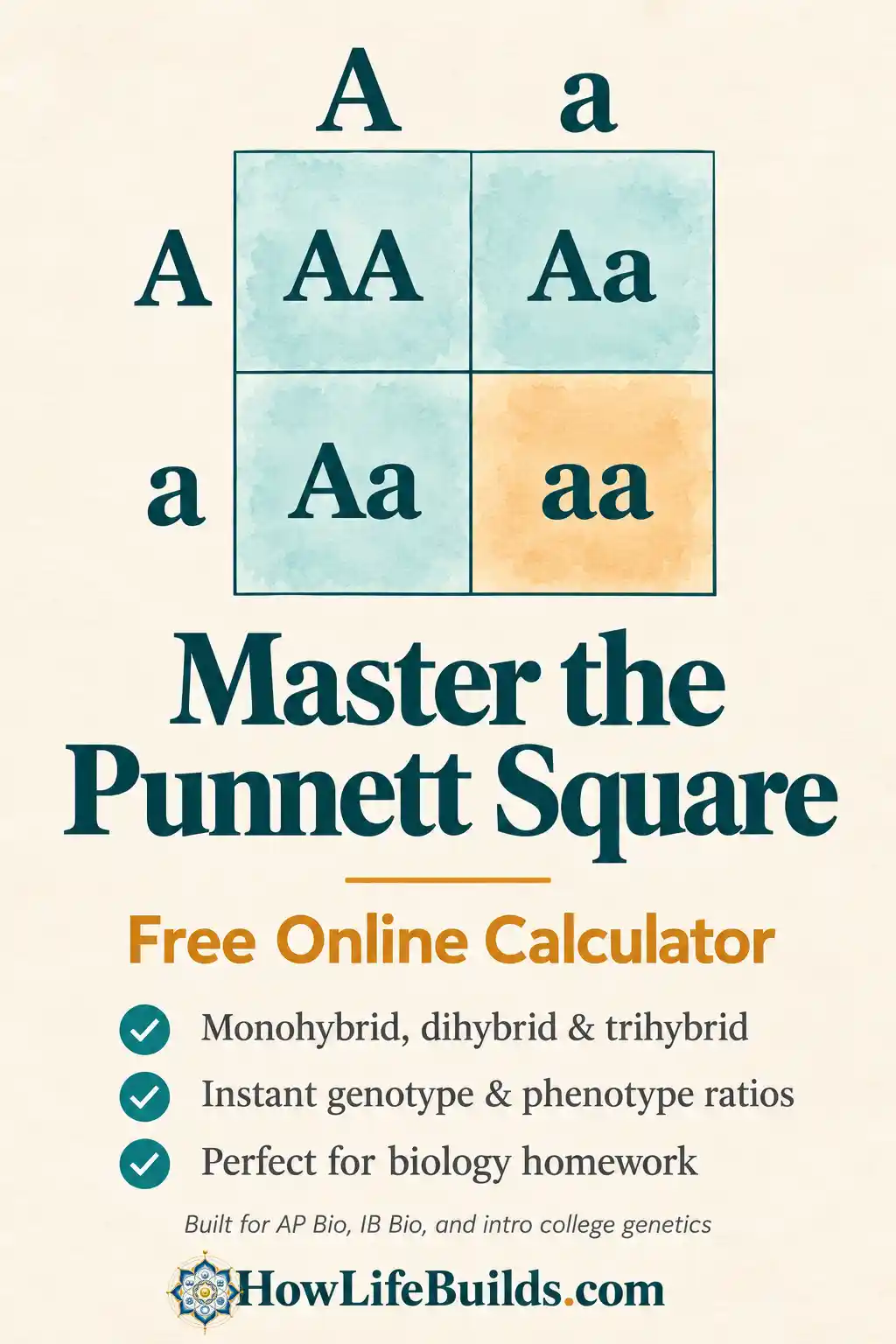
A Punnett square calculator instantly shows the possible offspring genotypes and phenotypes from any genetic cross. Enter two parent genotypes — like Aa × Aa for monohybrid or AaBb × AaBb for dihybrid — and get the complete square, genotype ratios, phenotype ratios, and probabilities for each combination.
What this calculator does
- Monohybrid, dihybrid, and trihybrid crosses — one, two, or three traits at once
- Full Punnett grid — 2×2, 4×4, or 8×8, color-coded by phenotype
- Genotype ratio — e.g., 1 AA : 2 Aa : 1 aa
- Phenotype ratio — e.g., 3 dominant : 1 recessive
- Probability percentages for each possible offspring type
- Preset classic crosses — Mendel's peas, eye color, cystic fibrosis carriers, and more
- Download or print a clean summary — perfect for homework and biology labs
Punnett Square Calculator
Enter two parent genotypes to see every possible offspring combination, with genotype and phenotype ratios.
Keep learning
What is a Punnett square?
A Punnett square is a simple grid used to predict the possible genetic outcomes when two parents reproduce. It was invented by the British geneticist Reginald C. Punnett in 1905 as a visual teaching tool to show how Gregor Mendel's laws of inheritance play out at the level of individual offspring.
The idea is elegant: write one parent's possible gametes (sex cells carrying one copy of each gene) along the top, write the other parent's gametes down the side, and fill in each cell with the combination. Every cell represents one possible offspring, and every cell is equally likely.
The vocabulary of inheritance
Before using a Punnett square, five terms do the heavy lifting:
Allele
One version of a gene. For eye color, "brown" and "blue" are alleles of the eye-color gene. Each parent carries two alleles for every gene — one on each chromosome.
Dominant / Recessive
A dominant allele shows its effect even when paired with a different allele. A recessive allele only shows when paired with another copy of itself. Capital letters mark dominant alleles (A); lowercase marks recessive (a).
Homozygous / Heterozygous
Homozygous means both alleles for a trait are the same (AA or aa). Heterozygous means they differ (Aa). A heterozygous individual with a recessive allele is a carrier.
Genotype vs Phenotype
Genotype is the allele combination (Aa, AA, aa). Phenotype is what you actually observe — the trait expressed. Both AA and Aa can produce the same phenotype if A is dominant.
Monohybrid crosses: one trait at a time
A monohybrid cross looks at a single trait controlled by one gene with two alleles. The classic example is Mendel's pea plant tallness experiment.
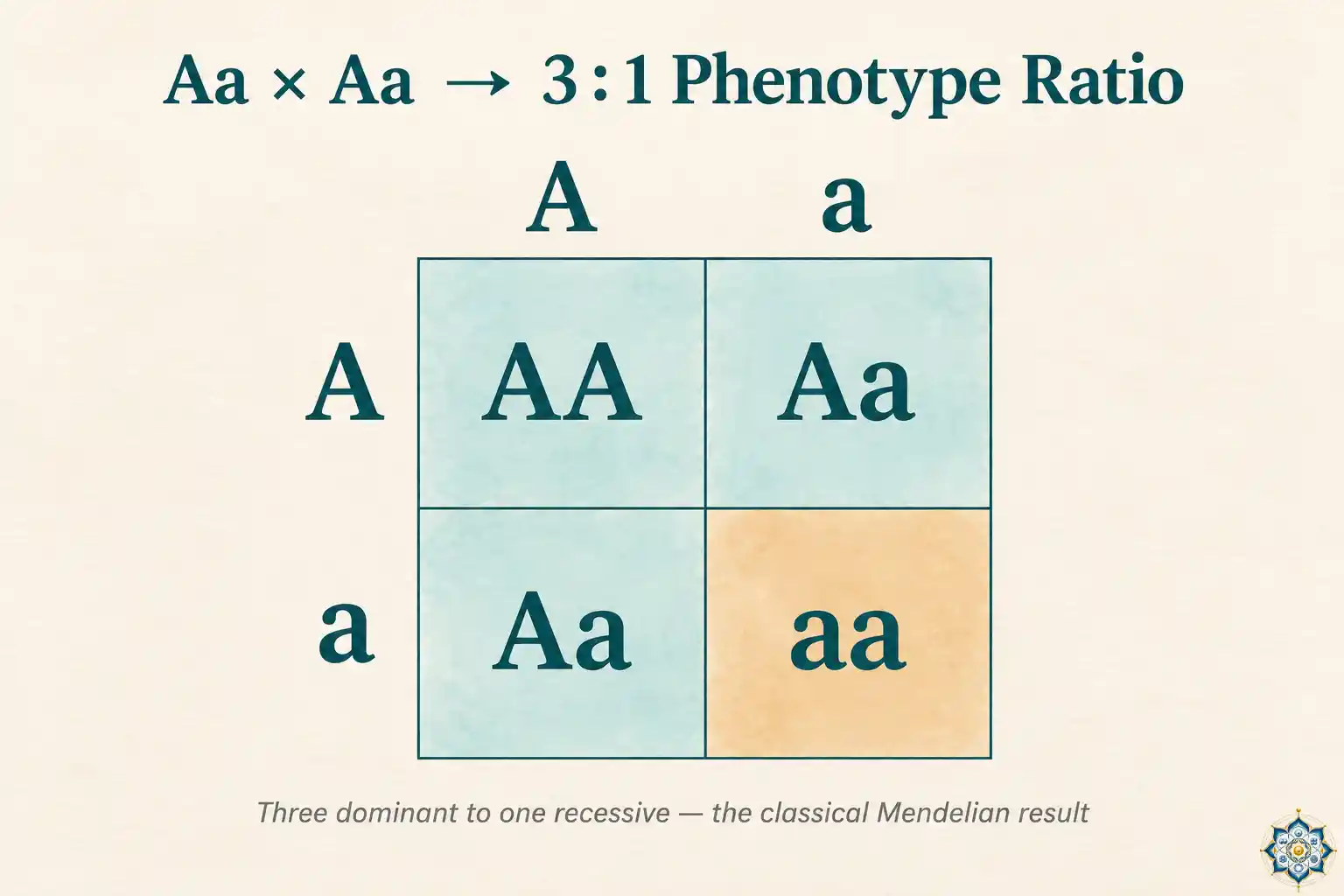
If both parents are heterozygous (Aa × Aa), each produces two kinds of gametes: half carry A, half carry a. The 2×2 Punnett square has four cells:
This gives the famous Mendelian ratios:
- Genotype ratio: 1 AA : 2 Aa : 1 aa
- Phenotype ratio: 3 dominant : 1 recessive (because AA and Aa look the same)
- Probability of recessive phenotype: 25% per offspring
Dihybrid crosses: two traits and independent assortment
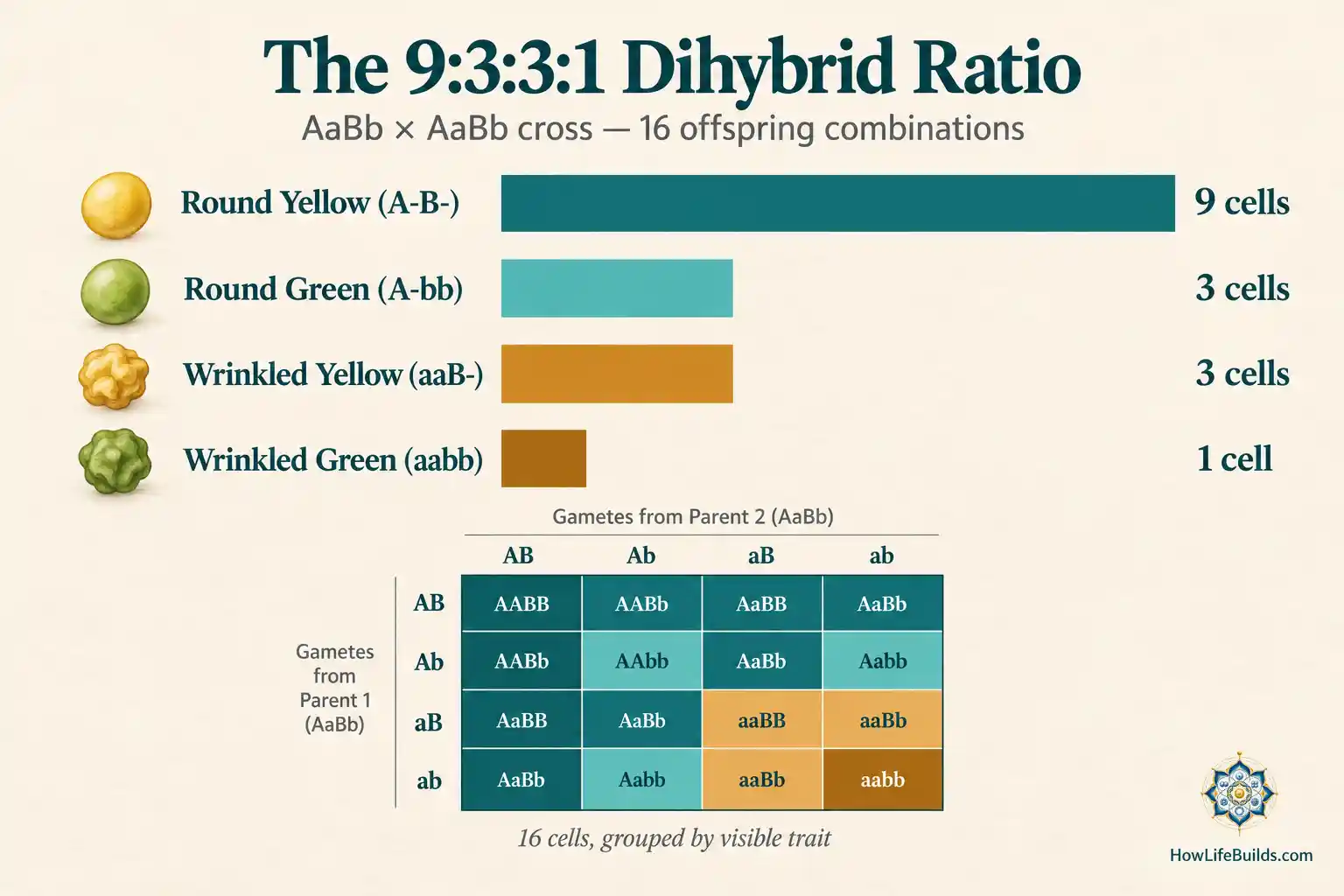
A dihybrid cross tracks two traits at once, like seed shape AND seed color. If each parent is heterozygous for both (AaBb × AaBb), each produces four kinds of gametes: AB, Ab, aB, ab.
The 4×4 grid has 16 cells. If the two genes are on different chromosomes, they assort independently (Mendel's Second Law), giving the signature:
- 9 : 3 : 3 : 1 phenotype ratio (both dominant : one dominant : the other dominant : both recessive)
- Nine distinct genotypes among the 16 cells
This 9:3:3:1 result is one of the most famous numbers in genetics. It only holds when:
- Both traits follow complete dominance
- The two genes are on different chromosomes (unlinked)
- Alleles segregate randomly during meiosis
Trihybrid crosses: three traits and 64 outcomes
A trihybrid cross tracks three traits. With three heterozygous pairs (AaBbCc × AaBbCc), each parent makes 8 kinds of gametes, producing an 8×8 grid with 64 cells. The classic trihybrid phenotype ratio is 27 : 9 : 9 : 9 : 3 : 3 : 3 : 1 — eight phenotypic categories.
Trihybrid squares get hard to draw by hand. That's where this calculator earns its keep.
Common traits that follow Mendelian inheritance
Many human and plant traits inherited through single genes with clear dominance patterns:
| Trait | Dominant | Recessive |
|---|---|---|
| Earlobes | Detached (free) | Attached |
| Hairline | Widow's peak | Straight hairline |
| PTC taste | Taster (bitter) | Non-taster |
| Tongue rolling | Able to roll | Unable to roll |
| Hitchhiker's thumb | Straight thumb | Hitchhiker's thumb |
| Cystic fibrosis | Unaffected | Affected (ff) |
| Sickle cell disease | Unaffected (incomplete) | Affected (ss) |
| Pea seed shape (Mendel) | Round | Wrinkled |
Some commonly taught "Mendelian" human traits — eye color, tongue rolling, earlobe attachment — are now known to be more complex than textbooks suggest. They involve multiple genes and environmental factors, so a Punnett square gives a useful teaching illustration but not a precise prediction.
What Punnett squares cannot predict
Punnett squares are a model, not reality. They work beautifully for simple Mendelian traits but fail in several important situations:
- Incomplete dominance — heterozygotes look intermediate (e.g., red × white snapdragons → pink)
- Codominance — both alleles are fully expressed (e.g., AB blood type)
- Polygenic traits — multiple genes influence one trait (height, skin color, intelligence)
- Pleiotropy — one gene affects multiple traits
- Epistasis — one gene masks the effect of another
- Linkage — genes close together on the same chromosome don't assort independently
- X-linked inheritance — sex chromosomes complicate the standard square
- Environmental influence — nutrition, temperature, and stress affect phenotype even with the same genotype
- Mitochondrial DNA — inherited only from the mother, independent of nuclear genes
For a deeper look at how DNA actually works — and why humans are 99.9% identical despite enormous phenotypic variation — see our pillar article on human genetic variation.
Punnett squares and genetic counseling
For single-gene recessive disorders like cystic fibrosis, sickle cell disease, Tay-Sachs, and phenylketonuria (PKU), Punnett squares give clinically useful risk estimates. A classic case: two cystic fibrosis carriers (both Ff) have a 25% chance per pregnancy of having an affected child (ff), a 50% chance of a carrier child (Ff), and a 25% chance of a non-carrier child (FF).
Frequently Asked Questions
How do you read a Punnett square?
Each cell shows one possible offspring genotype formed by combining one gamete from each parent (the letter on top for one parent, the letter on the left for the other). Every cell is equally likely. Count how many cells match each phenotype to get the ratio and the probability.
What's the difference between genotype and phenotype?
Genotype is the actual pair of alleles an individual carries (AA, Aa, or aa). Phenotype is the observable trait that results (brown eyes, blue eyes). With complete dominance, AA and Aa produce the same phenotype — both brown eyes — even though their genotypes differ.
What is a monohybrid cross?
A monohybrid cross tracks one trait controlled by one gene. The classic Aa × Aa cross produces a 2×2 grid with the famous 3:1 phenotype ratio (3 dominant to 1 recessive) and a 1:2:1 genotype ratio.
What is the 9:3:3:1 ratio?
The 9:3:3:1 ratio appears in a dihybrid cross between two heterozygotes (AaBb × AaBb) when both traits show complete dominance and the two genes are on different chromosomes. Nine offspring show both dominant traits, three show only the first dominant, three show only the second dominant, and one shows both recessive traits.
Can a Punnett square predict exactly what my children will look like?
No. Punnett squares give probabilities, not certainties. Each pregnancy is an independent event. Two heterozygous parents (Aa × Aa) could, by chance, have four children who are all AA, all aa, or any other combination — the ratios are population-level expectations, not guarantees.
Why doesn't a Punnett square work for eye color or height?
Those traits are polygenic — many genes contribute to the final phenotype, each adding a small effect, often influenced by environment. A Punnett square can only model one or a few genes at a time, so it can't capture traits like height, intelligence, or skin color that depend on dozens of genes.
What is a carrier?
A carrier is a heterozygous individual (Aa) who has one dominant and one recessive allele for a trait. For recessive genetic conditions, carriers don't show the condition themselves but can pass the recessive allele to their children. If two carriers have a child together, there's a 25% chance per pregnancy of an affected (aa) child.