An ovulation calculator uses your menstrual cycle data to predict your fertile window, the most likely day of ovulation, and the days with the highest chance of conception. This tool calculates based on your last period, cycle length, and luteal phase — and shows your cycle as a visual map with a per-day probability of conception based on peer-reviewed research (Wilcox et al., 1995).
What this calculator tells you
- Your fertile window — the 6-day window during your cycle when conception is possible
- Peak fertility days — the 2-3 days with the highest conception probability
- Estimated ovulation date — when the egg is most likely to be released
- Next period date — the earliest day to take a reliable pregnancy test
- Projected due date — if you conceive this cycle
- A cycle map — click any day for details on what's happening in your body
Ovulation Calculator
Find your fertile window, your most likely ovulation day, and what is happening in your ovary at each stage of your cycle.
Related tools & articles
How ovulation actually works
Ovulation is the moment when your ovary releases a mature egg (oocyte) that can be fertilized by a sperm. But that one event is the climax of a hormonal cascade that takes about two weeks to build. Understanding that cascade is the key to understanding why some days of your cycle are fertile and others aren't.
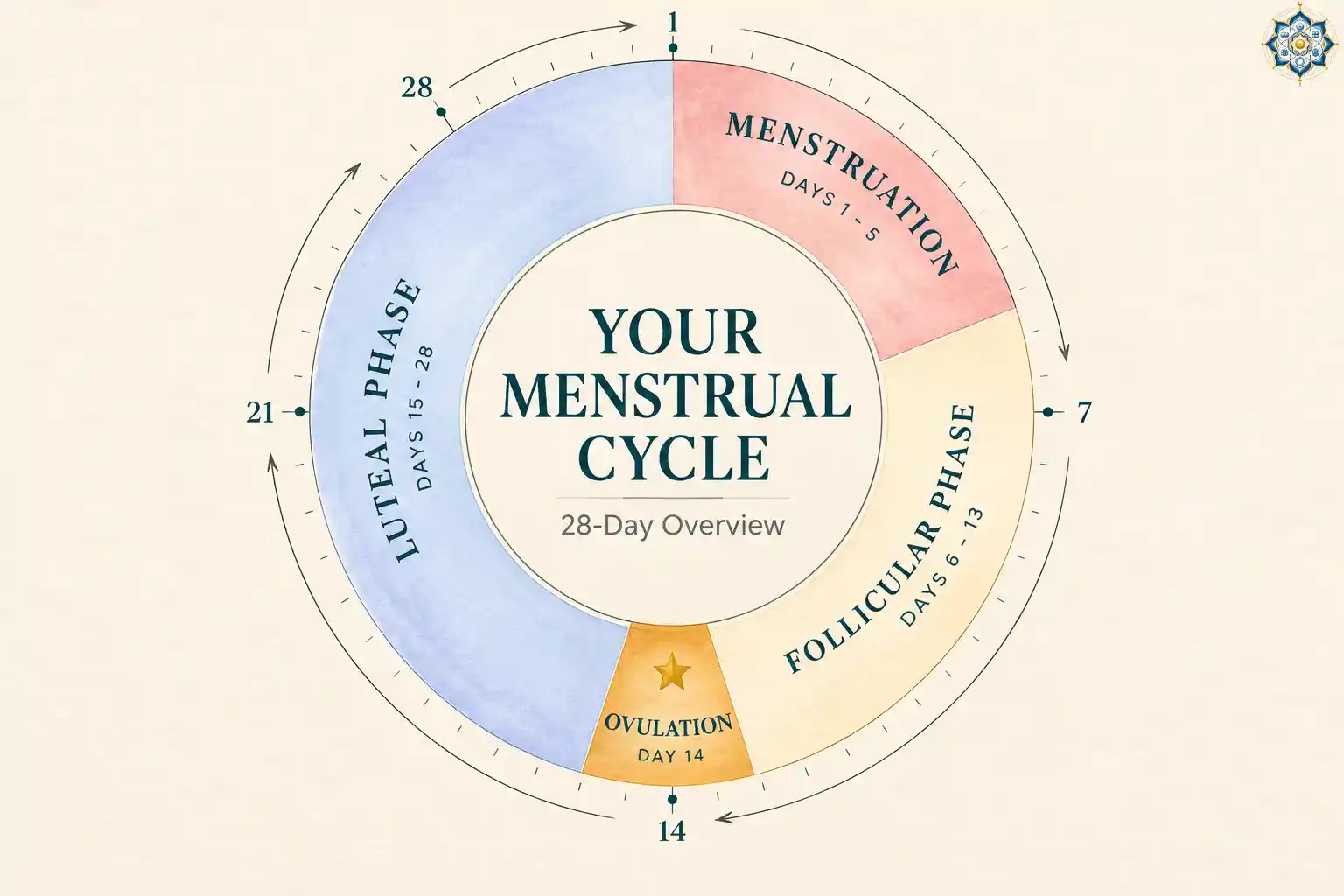
The four phases of your menstrual cycle
Menstruation
Falling progesterone causes the uterine lining to shed. Meanwhile, rising FSH (follicle-stimulating hormone) is already recruiting a group of follicles in the ovaries. Day 1 of your period = Day 1 of your cycle.
Follicular Phase
FSH drives the follicle cohort to grow. Around day 5-7, one follicle becomes dominant while the others regress. The dominant follicle produces estradiol, which rebuilds the uterine lining and thins cervical mucus.
Ovulation
Sustained high estradiol triggers the LH surge. 24-36 hours later, the follicle ruptures and releases the mature egg into the fallopian tube. The egg survives 12-24 hours — this is the fertilizable window.
Luteal Phase
The ruptured follicle becomes the corpus luteum and produces progesterone, which maintains the uterine lining. If no implantation occurs, the corpus luteum degrades after ~14 days — then the cycle restarts.
The fertile window: why it's 6 days, not 1
Here's one of the most important facts in reproductive biology: the fertile window is about 6 days long, not 1. This isn't because the egg lives for 6 days. It's because sperm do.
- The egg survives: 12 to 24 hours after ovulation
- Sperm survive: up to 5 days inside the female reproductive tract (in fertile-quality cervical mucus)
Add them together, and the fertile window becomes: 5 days before ovulation + ovulation day = 6 days total.
Probability of conception by day
In a landmark 1995 study published in the New England Journal of Medicine, Allen Wilcox and colleagues tracked conception outcomes in 221 healthy women and calculated the per-day probability of conception from intercourse on each day of the fertile window:
| Day relative to ovulation | Chance of conception |
|---|---|
| 5 days before ovulation | ~10% |
| 4 days before ovulation | ~16% |
| 3 days before ovulation | ~14% |
| 2 days before ovulation | ~27% |
| 1 day before ovulation | ~31% |
| Day of ovulation | ~33% |
| 1 day after ovulation | Near zero |
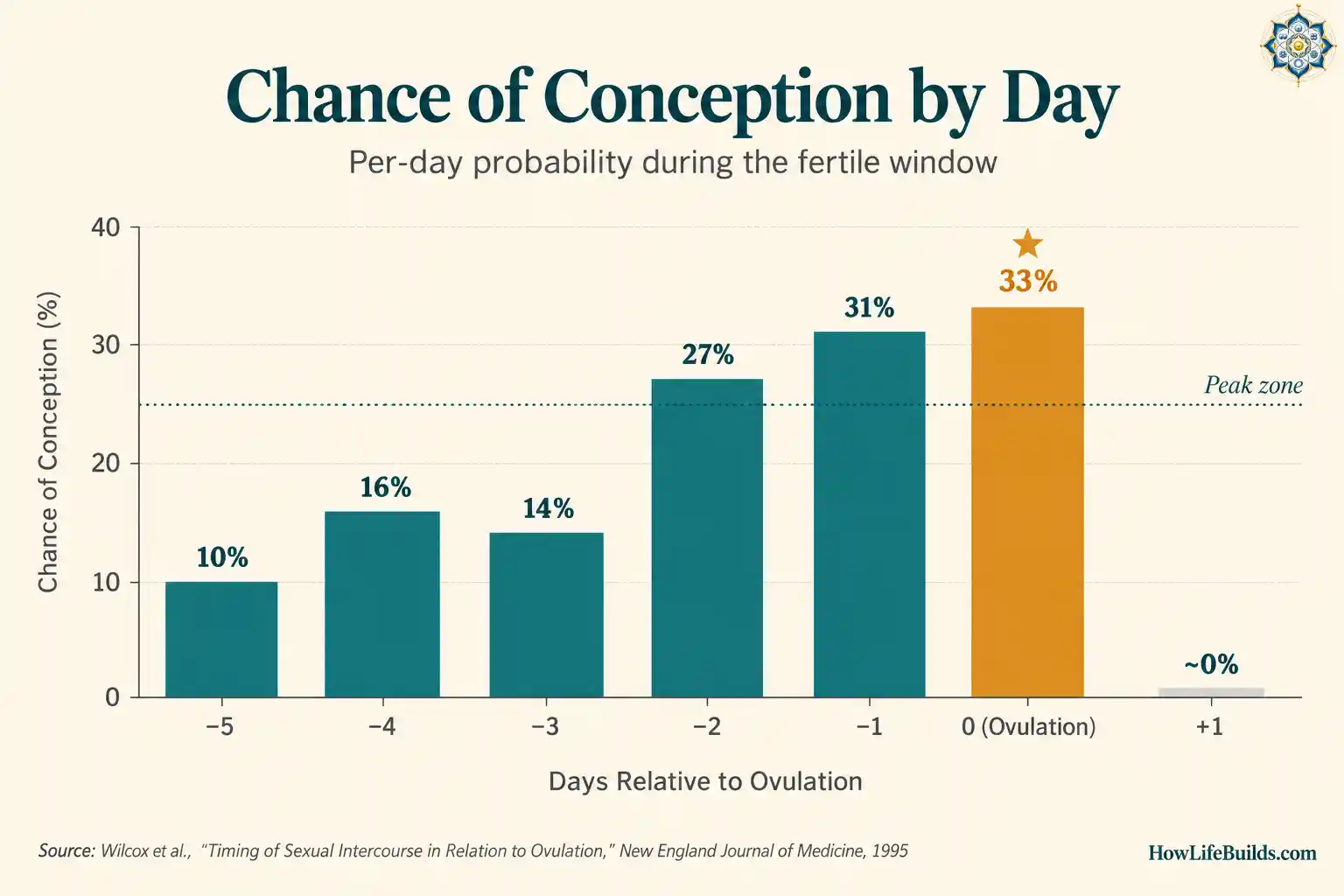
The two days before ovulation and ovulation day itself are the peak. If you're trying to conceive, these three days matter most.
Signs that ovulation is happening
Your body gives several reliable signals around ovulation. Learning to recognize them is more accurate than calendar prediction alone, especially if your cycles are irregular.
Cervical mucus changes
As estradiol rises in the days before ovulation, cervical mucus becomes clear, slippery, and stretchy — often described as resembling raw egg white. This "fertile mucus" helps sperm survive and swim. After ovulation, progesterone makes mucus thick, cloudy, and sticky — hostile to sperm.
Basal body temperature (BBT)
Progesterone, released by the corpus luteum after ovulation, raises your resting body temperature by about 0.3-0.6°C (0.5-1.0°F). Tracking BBT with a sensitive thermometer first thing in the morning can confirm ovulation retrospectively (after it happened), but doesn't predict it in advance.
LH surge (ovulation predictor kits)
Urine ovulation strips detect the surge of luteinizing hormone 24-36 hours before ovulation. These are the most reliable way to predict ovulation in real time. Start testing 3-4 days before your calculated ovulation day.
Ovulation pain (mittelschmerz)
About 20% of women feel a mild one-sided pelvic ache around ovulation. It's caused by the follicle rupture and some fluid release into the pelvis. If you experience it consistently, it can be a useful personal signal.
Other signs
Some women report increased libido, breast tenderness, a sharper sense of smell, mild bloating, or very light spotting around ovulation. These are less reliable but can add to the picture.
What shifts your ovulation timing?
Even in regular cyclers, ovulation isn't a fixed clock. The follicular phase (before ovulation) is especially variable. Several factors can delay or shift it:
- Stress — physical or emotional stress can suppress GnRH, delaying the LH surge
- Illness — fever or infection often postpones ovulation
- Travel — jet lag and schedule disruption affects circadian rhythms
- Weight changes — significant gain or loss affects estradiol production
- Intense exercise — athletic training can push ovulation later or cause it to skip
- Age — in the late 30s and 40s, cycle length often shortens, with ovulation moving earlier
- Coming off hormonal birth control — the first few cycles after stopping can be erratic
- PCOS or thyroid issues — can cause irregular or absent ovulation
Methods for tracking ovulation compared
| Method | How it works | Accuracy |
|---|---|---|
| Calendar method | Subtract luteal phase (14 days) from cycle length | Good for regular 26-32 day cycles; unreliable for irregular |
| Cervical mucus tracking | Observe daily changes in mucus texture | Useful signal; requires daily attention |
| Basal body temperature | Daily morning temperature readings | Confirms ovulation after it occurred (not predictive) |
| LH ovulation strips | Detect LH surge in urine | Highly predictive — 24-36 hours before ovulation |
| Fertility monitors | Track multiple hormones (LH + estrogen) | Most accurate at-home option |
| Ultrasound follicle tracking | Clinical imaging of follicle growth | Gold standard — used in fertility treatment |
For most people trying to conceive, combining the calendar method with LH strips and cervical mucus observation gives excellent coverage.
How often should you have sex during the fertile window?
Common wisdom used to say "save it up for ovulation day." Modern research says the opposite: frequent intercourse through the fertile window is the most effective approach.
- Every day during the fertile window — slightly higher conception rate than every-other-day
- Every 1-2 days through the fertile window — nearly as effective, less stressful
- Only on ovulation day — misses the earlier high-probability days
There's no benefit to "saving up" sperm for ovulation day. Daily ejaculation does not meaningfully deplete healthy sperm counts and may even improve motility by clearing older sperm from storage.
When to see a doctor about fertility
Standard guidance for when to seek a fertility evaluation:
- Under 35: After 12 months of trying without conception
- 35-39: After 6 months of trying
- 40 and older: After 3 months of trying, or ideally before starting
- Irregular or absent periods: Right away — don't wait
- Known conditions: PCOS, endometriosis, prior pelvic surgery, cancer treatment, or male infertility factors — see a doctor before trying or at the start
A standard initial fertility workup includes blood work (checking FSH, LH, estradiol, thyroid, prolactin, AMH), a semen analysis for the partner, and imaging to check tubal patency and the uterine cavity.
Important: this is not birth control
Frequently Asked Questions
How is ovulation calculated?
Ovulation is calculated by subtracting the luteal phase length (typically 14 days) from your cycle length. In a 28-day cycle, that puts ovulation around day 14. In a 35-day cycle, it falls around day 21. The luteal phase stays relatively constant across cycles — it's the follicular phase (before ovulation) that varies.
How long is the fertile window?
The fertile window is approximately 6 days long: the 5 days before ovulation plus ovulation day itself. Sperm can survive up to 5 days in the female reproductive tract when fertile cervical mucus is present. The egg survives only 12-24 hours after release, which is why the window closes shortly after ovulation.
Which days am I most likely to conceive?
The 2 days before ovulation and ovulation day itself have the highest conception probability — roughly 27-33% per act of intercourse for healthy couples (Wilcox et al., 1995). For healthy couples trying to conceive, the overall chance per cycle is about 20-25%, declining with age.
What if my cycles are irregular?
Calendar-based predictions become unreliable when cycle length varies by more than a few days. In that case, LH ovulation strips (which detect the surge 24-36 hours before ovulation), cervical mucus tracking, and basal body temperature charting give much better information than a calculator. Very irregular or absent cycles are worth discussing with a doctor.
Can I get pregnant during my period?
It's uncommon but possible, especially with short cycles. If you have a 22-day cycle and bleed for 5 days, you could ovulate as early as day 8 — just 3 days after bleeding stops. Combined with sperm surviving up to 5 days, intercourse on the last day of bleeding could lead to conception.
When should I take a pregnancy test?
The most reliable time is the first day of your missed period. Testing earlier can give a false negative because hCG — the hormone the test detects — is still rising after implantation. Highly sensitive tests can detect pregnancy 10-11 days after ovulation, but a negative at that point doesn't rule out pregnancy. Once you've got a positive result, use our pregnancy due date calculator to find your EDD and track weeks pregnant.
Can this calculator be used as contraception?
No. Calendar-based methods have a typical-use failure rate of around 24% per year — far too high for reliable contraception. Cycle length varies, ovulation can shift, and sperm live for up to 5 days. For effective birth control, speak with a healthcare provider about hormonal, barrier, or long-acting options.